An OpenAI model has advanced into a previously intractable area of discrete geometry, disproving a central conjecture that had resisted mathematical inquiry for roughly 80 years. The AI system, using a general-purpose reasoning model rather than one specifically built for mathematics, identified a new family of constructions that outperform the long-held belief in grid-like solutions. This development has stirred considerable interest among mathematicians, who see it as a compelling example of how artificial intelligence might not just solve problems but contribute to genuine discovery.
AI's role in research may expand beyond mere calculation, touching upon creative and conceptual aspects of discovery, with human judgment remaining a crucial element. The model's approach involved connecting the geometry problem to deep branches of mathematics, specifically algebraic number theory, a field not traditionally associated with such geometric puzzles. This cross-disciplinary leap highlights the evolving capabilities of AI reasoning systems.
Read More: Chrome mimeHandler API lets extensions handle file types
While OpenAI claims this marks the first time an AI has autonomously solved a prominent open mathematical problem, past assertions from the company have met with scrutiny. This latest announcement, however, appears to have garnered more widespread acknowledgment. Experts have noted the AI's apparent "patience and focus" in its process. The result also offers a glimpse into a potential future collaboration between AI and human researchers.
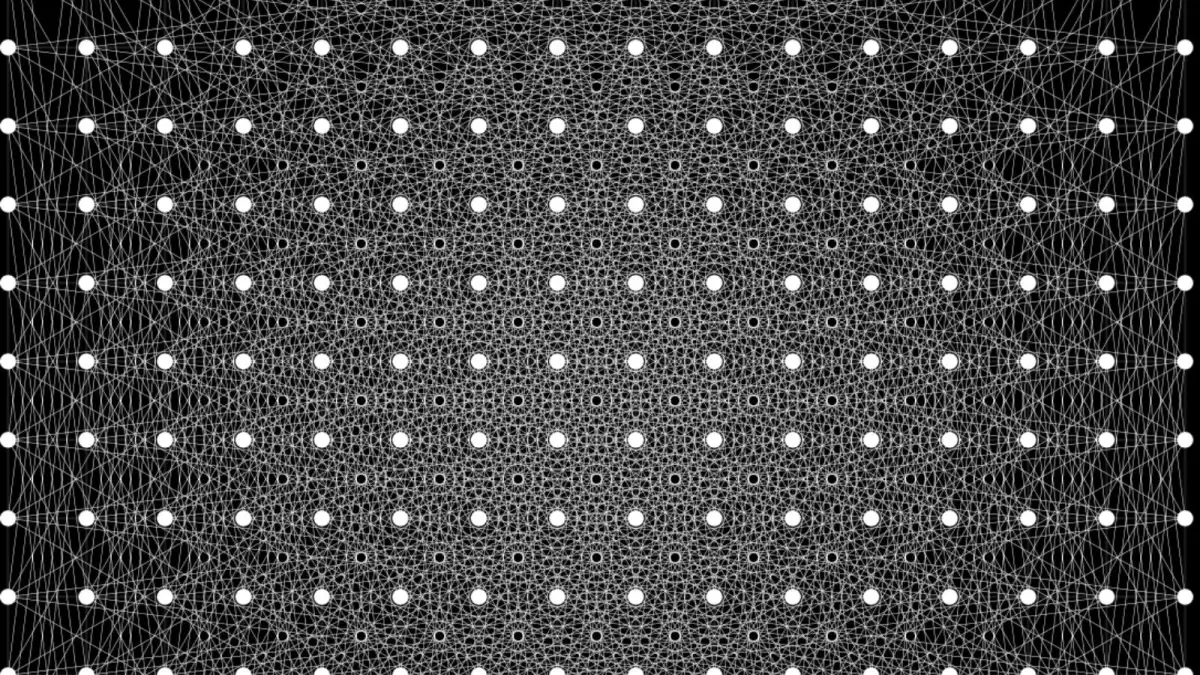
Nuances and Unanswered Questions
The nature of the AI's "solution" is not without its subtleties. While it demonstrated that the existing theoretical limit for the problem, proposed by mathematician Paul Erdős, was too low, it did not provide a precise new answer for the rate at which "pairs of dots rise." This means the broader problem, in its entirety, remains officially unsolved. Furthermore, while an edited version of the AI's reasoning process has been shared, the original output has not been made public for independent expert review.
Read More: Philosophers Rethink Zero's Meaning in Math and Logic
Even before this latest announcement, AI's progress in mathematical reasoning has been steadily increasing. However, the capacity for AI to undertake and resolve such complex, abstract problems marks a significant, if still debated, step forward. Some commentators have pointed out that mathematicians have already begun to build upon the AI's findings, with one mathematician, Will Sawin, reportedly improving upon the AI's own derived constructions.
A Legacy of Inquiry
The conjecture itself dates back to work by the prolific mathematician Paul Erdős, who in the 1940s and subsequent decades posed numerous influential problems in mathematics. For nearly eight decades, mathematicians had largely believed that the most efficient arrangements for certain geometric problems would resemble square grids. The AI's disproof of this long-standing belief opens up new avenues for exploration in discrete geometry and potentially other related fields.
Read More: BEREC Asks for Mobile Network API Ideas from Developers