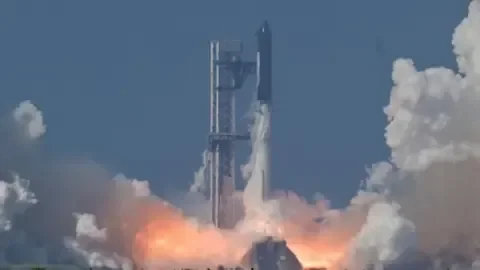
On 23 May 2026, SpaceX successfully launched the third generation of its Starship megarocket from the Starbase complex in Texas. The flight occurred one day after a scrubbed attempt on Thursday, where countdown irregularities related to fuel temperature and pressure forced a 24-hour delay.

The mission objectives focused on testing the structural integrity of the V3 architecture and satellite deployment mechanisms, though the flight concluded with a booster-stage failure regarding its "boost-back" burn. The upper stage eventually performed a controlled splashdown in the Indian Ocean, followed by an intentional disintegration upon impact.
Operational Performance Metrics
| Phase | Status | Outcome |
|---|---|---|
| Countdown (Thursday) | Aborted | Technical instability/Fuel pressure |
| Launch (Friday) | Success | Cleared pad |
| Boost-back Burn | Failed | Incomplete maneuver |
| Splashdown | Success | Planned destruction in ocean |
Key Fact: This test, internally designated as Flight 12, represents a pivot point for the company's financial and contractual roadmap.
Context: The rocket—standing approximately 400 feet tall—is central to the NASA Human Landing System contract and the expansion of the Starlink orbital network.
Financial Scope: Reports indicate SpaceX has funneled over $15 billion into the development of the Starship program, a figure that looms over the company's anticipated Initial Public Offering.
Strategic and Industrial Implications
The execution of this test follows a period of high intensity for the aerospace firm. Following the Thursday delay, which was attributed to last-minute engineering hurdles, the successful Friday launch provided a conclusion to a sequence marked by high public interest and significant fiscal pressure.
Read More: NASA Robot Mission Launched to Raise Swift Telescope Orbit, Add 10 Years
Elon Musk has previously attempted to calibrate public expectations, emphasizing that the factory at Starbase currently holds multiple V3 boosters and ship variants ready for production iteration. Despite the success of the overall flight, the failure of the boost-back maneuver highlights the recurring complexity in recovering super-heavy lift components.
The successful completion of this test provides the necessary data for the firm’s long-term goal of rapid reusability. As the company prepares for its projected June IPO, the ability to maintain a consistent flight cadence remains the primary variable in demonstrating the commercial viability of the Starship architecture.