Venice, Italy – May 16, 2026 – The 61st Venice Biennale, a global nexus for contemporary art, has opened its doors, but not without significant friction. The prestigious exhibition finds itself entangled in a web of geopolitical fractures, with protests and temporary pavilion closures disrupting its typically vibrant launch. This year’s event, curated under the shadow of what is described as an “age of grief and geopolitical fracture,” places a stated emphasis on marginalized voices and overlooked locales.
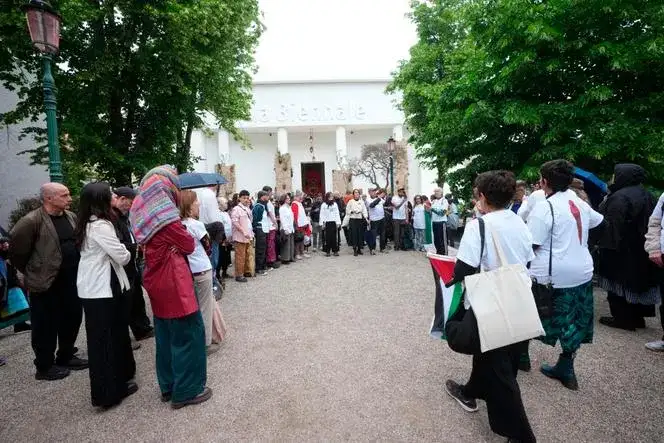
Discontent Erupts Over National Inclusions
A palpable tension has marked the opening days of the Biennale, primarily fueled by the inclusion of Russia and Israel. Ukraine has been a vocal opponent of Russia's participation, staging protests to challenge its return to the fair for the first time since the full-scale invasion. The controversy has exposed a division between the Biennale’s governing board and its international jury, the body responsible for awarding top prizes.
Read More: Banana Art Stolen From French Museum, Replaced Quickly

This discontent manifested physically as multiple national pavilions temporarily shuttered their doors in protest. The Belgian, Dutch, Austrian, Japanese, Macedonian, and Korean pavilions were among those closed for periods on opening day. The British, Spanish, French, Egyptian, Finnish, and Luxembourgish pavilions also saw closures or limited hours. Italy's own culture minister declined to attend the opening ceremony, signaling a government stance aligned with the disquiet. Activist groups, including Pussy Riot and Femen, staged direct protests outside the Russian pavilion.

South Asian Artistry Takes Center Stage Amidst Global Strife
Against this backdrop of international discord, the Indian pavilion presents a significant homecoming, featuring artists like Asim Waqif with his large-scale bamboo installation, Ranjani Shettar with resin-coated natural forms, and Skarma Sonam Tashi’s “Echoes of Home.” Alwar Balasubramaniam’s earthworks and Sumakshi Singh’s thread installations also contribute to the exhibition's exploration of memory and materiality. Further afield, Ashfika Rahman's installation “Than Para – No Land Without Us” appears within a collateral event focusing on Ukraine. Other notable South Asian contributions include Nalini Malani’s “Of Woman Born Elsewhere” and Paresh Maity’s abstract sculpture, “Equilibrium.”
Read More: AFP Reviews War Crime Claims Against Australian in Gaza

Curatorial Vision in "Minor Keys"
The overarching curatorial vision, helmed by the late Koyo Kouoh (whose work is being honored after her passing in May 2025), seeks pockets of intimacy within a "loud, frenzied, and unstable" world. The exhibition’s thematic approach, described as being in "minor keys," aims to evoke a somber, sad, and mysterious tone, while simultaneously offering avenues for "joy, solace, hope and transcendence." Key motifs woven throughout the exhibition include "Shrines," "processional assemblies," "enchantment in the face of cynicism," and "spiritual and physical rest."
The Biennale Arte 2026 showcases works from 99 nations, with 100 national participations spread across various venues. Notably, seven countries are participating for the first time: the Republic of Guinea, the Republic of Equatorial Guinea, the Republic of Nauru, Qatar, the Republic of Sierra Leone, the Federal Republic of Somalia, and the Socialist Republic of Viet Nam. Additionally, El Salvador makes its debut with its own pavilion.
Read More: Indian artists use Instagram for anti-caste art
Background: A Festival of Global Expression
The Venice Biennale, established in 1895, is one of the world's oldest and most influential contemporary art exhibitions. Held biennially, it provides a platform for national pavilions and a curated international exhibition, drawing millions of visitors and shaping global art discourse. The 61st edition, running from May 9th to November 22nd, 2026, continues this tradition, albeit under a cloud of global unease and artistic dissent. The institution has maintained that the protests and strikes do not involve its staff or organizational structure.
Read More: Indus Waters Treaty remains suspended in India and Pakistan April 2026