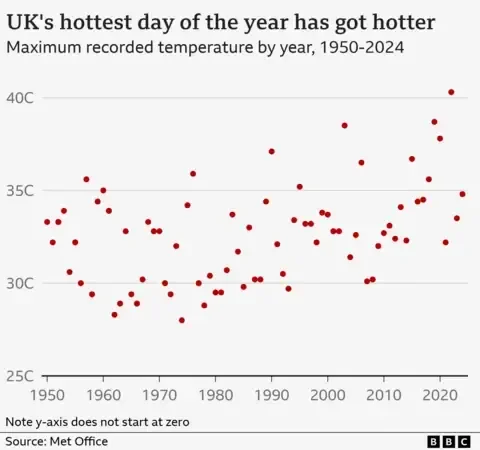
London – Yesterday's peak temperatures, soaring to 34.8°C in parts of the country, have provisionally set a new daily record for spring and May in the United Kingdom. This stark figure, while perhaps appearing moderate elsewhere, has prompted widespread comment and discomfort, leading to the persistent question: why does 30°C feel so much worse in the UK? Experts point to a confluence of factors: high atmospheric humidity, a fundamental lack of air conditioning in homes and public spaces, and the underlying reality that the nation's infrastructure is simply not designed for sustained heat.

The core of the issue lies in the UK's unpreparedness for intense heat, amplified by environmental conditions and structural deficiencies. High humidity prevents efficient heat loss from the body, making even moderately high temperatures feel oppressive. Coupled with a widespread absence of cooling systems, common in warmer climates, and buildings designed for insulation against cold rather than dissipation of heat, the experience of a heatwave becomes acutely uncomfortable. This contrast is stark when compared to holiday destinations like Spain or Italy, where similar temperatures are often perceived as pleasant.
Read More: Mumbai Red Alert July 2026 Causes School Closures and Train Delays

Infrastructure and Expectation
British homes, built with insulation paramount for cold winters, tend to retain heat stubbornly. This architectural legacy means that when temperatures rise, homes become inadvertent ovens.

Many UK homes are well-insulated, designed to keep warmth in during colder months. This design choice significantly hinders the expulsion of heat during summer.
There's a marked lack of air conditioning prevalent in British residences and commercial buildings, a common feature in countries accustomed to hotter climates.
A psychological element also plays a role: Britons are often less mentally prepared for prolonged heatwaves compared to individuals in countries where such conditions are a regular occurrence. This lack of expectation can exacerbate the perceived discomfort.
The Science of Feeling Hot
Meteorologists often employ 'feels like' temperatures, which go beyond mere air temperature to consider how conditions impact the human body. The primary mechanisms for heat loss – radiation, conduction, convection, and evaporation – are all hampered by the prevailing conditions.
Humidity is a critical, often overlooked, element. High humidity impedes the body's ability to cool itself through evaporation – the sweat that would normally provide relief becomes ineffective.
When the ambient air temperature is close to or exceeds body temperature, the temperature gradient that allows for heat loss becomes negligible or even reversed.
Climate Change as an Amplifier
Underpinning these immediate factors is the undeniable influence of climate change. Scientists confirm that global warming is making heatwaves in the UK:
More frequent.
More intense.
And of longer duration.
This trend suggests that the conditions contributing to the current discomfort are likely to become more pronounced and commonplace in the future. The UK Health Security Agency (UKHSA) has responded by issuing amber heat health alerts across several regions, including London and the South East, indicating the seriousness with which these elevated temperatures are now being viewed, not just for comfort but for public health risks.
Read More: Tess Daly wears wedding ring in London after split from Vernon Kay
A Record-Breaking Day
Yesterday's sweltering conditions saw temperatures climb significantly across the nation, with multiple locations exceeding the provisional record.
London: Heathrow recorded 34.4°C, while Northolt reached 34.2°C.
Greater London: Teddington Bushy Park saw 34.0°C.
Oxfordshire: Benson hit 33.6°C.
Surrey: Wisley recorded 33.3°C.
Berkshire: Reading University noted 33.2°C, alongside Cippenham at 33.0°C.
Warwickshire: Wellesbourne also registered 33.2°C.
Oxfordshire: Brize Norton reached 32.9°C.
Surrey: Charlwood peaked at 32.9°C.
Norfolk: Houghton Hall hit 32.9°C.
Suffolk: Santon Downham registered 32.9°C.
These figures underscore the widespread nature of the heat, painting a picture of a country grappling with an unaccustomed level of warmth. The situation raises concerns about potential disruptions to transport and power systems, and indeed, poses a risk to life, as highlighted by the Met Office's warnings.